
Localidad proyecto: Barcelona
LANDSCAPING OF LAS CASERNAS DE SANT ANDREU
CLIENT: BAGURSA
Barcelona (Spain)
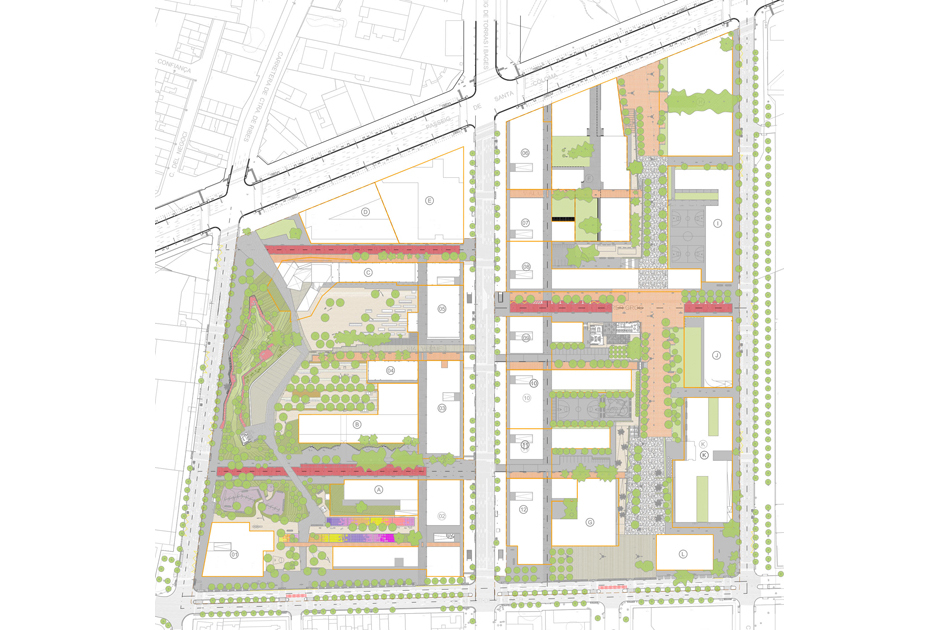
The transformation of the activity of the old Casernas de Sant Andreu allowed the incorporation of two important areas of 5 and 6 ha into the city. The modification of the General Metropolitan Plan for Casernes de Sant Andreu in Sector III of the Sant Andreu-Sagrera MPGM allows the future integration of the land within its own environment and that of the city, the definition and delimiting of parts for residential use, equipment and free spaces.
Two systems of public spaces are proposed for these 11 ha that continue the urban structure of the district. To the west, a large park that continues the pedestrian routes in the section and that is enclosed by the library and the homes for the aged and for students. To the east, an avenue of equipment for the district. In the middle, the residential and commercial area concentrated on the Torres i Bages promenade, configured as a powerful line of buildings relating the public scale of Sant Andreu i la Trinitat. This line, with porch and businesses on the ground floor and homes on four storeys, allows transverse flows to the equipment and public spaces on the sides. Residential blocks are mixed in with the public equipment in longitudinal bands following the lines of the existing trees.
The project is developed from the Criterios document written by the architect Solà-Morales.
PRELIMINARY MOBILITY STUDY IN THE AMBIT OF THE FINAL SECTION OF THE RIVER LLOBREGAT VALLEY AND STUDY OF ALTERNATIVES FOR THE JUNCTION OF QUATRE CAMINS AND THE BV-2002 BYPASS
CLIENT: BARCELONA METROPOLITAN AREA (AMB)
Barcelona (Spain)
The Barcelona Metropolitan Area commissioned Esteyco to prepare the study analysing alternatives for modifying the Quatre Camins junction, one of the most important in the Barcelona metropolitan system in the ambit of the final section of the River Llobregat valley. The Quatre Camins crossroads is a multi-level cloverleaf junction with the features of the road system built in the 1960s where its type made sense due to its location in the joining point of the N-II and the N-340.
With the putting into service of the AP2, A2 and B24 and with the expectation of new road connections in the area, this junction has become an obsolete infrastructure, completely over-sized for the current traffic it has to carry.
This situation, together with the appearance of the Quatre Camins FGC station, provides the opportunity to convert this ambit into a large inter-modal space in metropolitan mobility.
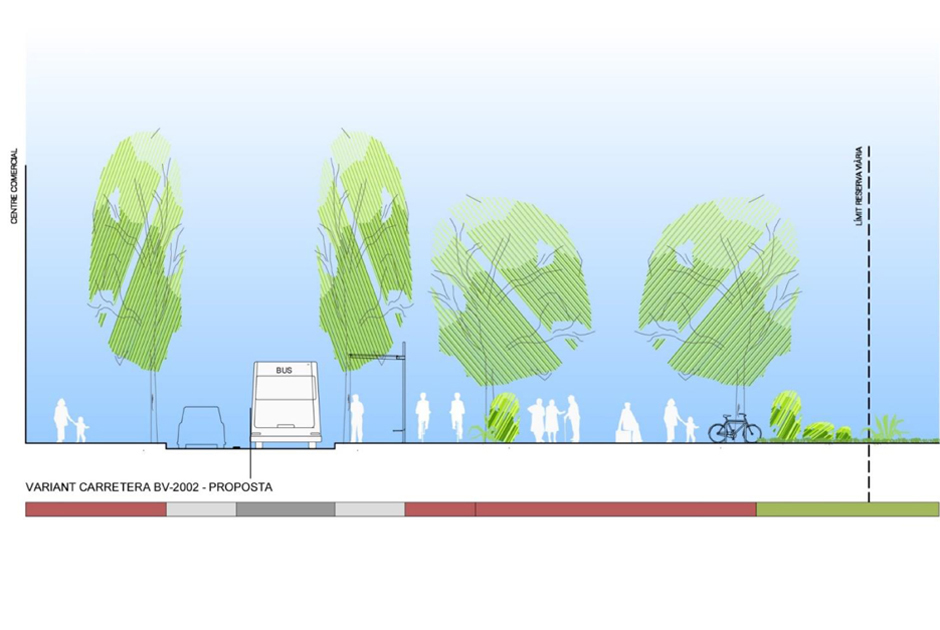
The study analyses the mobility scenarios in the corridor in the lower valley of the River Llobregat and suggests various proposals for converting the junction, considering new road sections and allowing the implementation of the tramway and pedestrian and bicycle routes.
REMODELLING OF THE MOLL DE LA FUSTA
CLIENT: SOCIEDAD MUNICIPAL DE APARCAMIENTOS Y SERVICIOS
Barcelona (Spain)
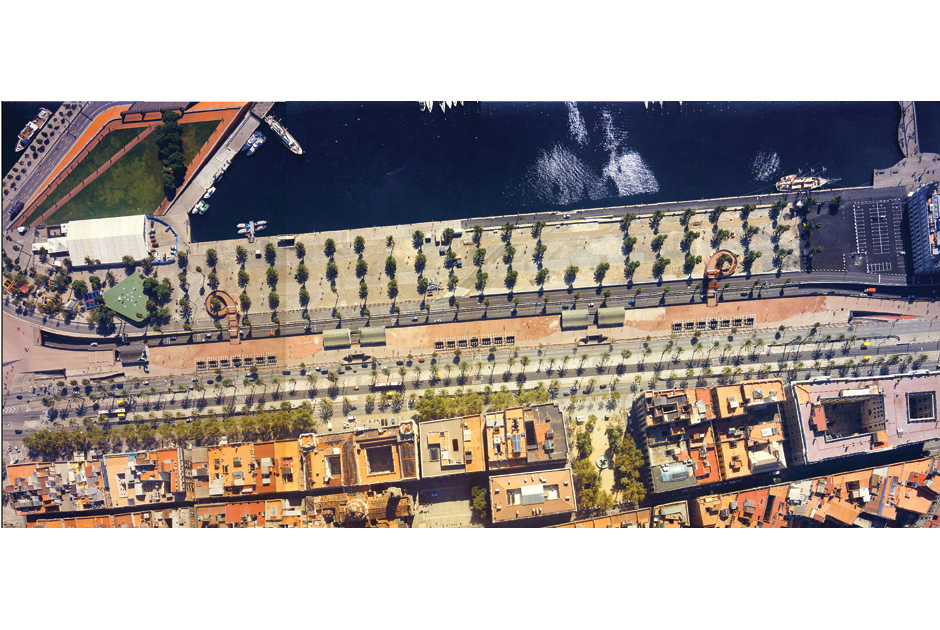
The remodelling of the Moll de la Fusta is designed to strengthen the character of the promenade, moving the fixed activities undertaken in the existing pavilions to the background. To ensure the physical and visual continuity of the new space, the underground car park vents were covered, the existing “trancadit” benches were removed, new slabs were built on the existing openings on the Ronda Litoral and the existing volumes were lightened, demolishing the buildings’ stone walls.
The new configuration of the promenade was formalised with the arrangement of a continuous plane paved with two types of contrasting wood, ipé and copper-treated pine, garden elements were incorporated along the existing pergolas and a 5 m wide band of micro agglomerate was laid on the sea side running longitudinally along the promenade in contact with the existing balustrade. The new limit on the city side was re-planned, modifying the access to the car park from the Vía Layetana and enlarging the promenade and making it more accessible to pedestrian flows with ramps and wide stepped sections.
There are two new buildings mixed among the existing pergolas next to the Paseo de Colón and facing the sea, thus providing adjoining shaded areas. These are two simple volumes, parallelepiped, measuring 47.7 x 7.80 m, roofed with a white concrete slab with exterior walls of folding sheets of wood and glass on the Colón and promenade sides, respectively.
MERCAT DE SANT ANTONI
CLIENT: RAVETLLAT I RIBES ARQUITECTES
Barcelona (Spain)
Esteyco developed the projects for the underground structure and the rehabilitation and consolidation of the Sant Antoni Market heritage building and undertook the project management and health and safety coordination for the works.
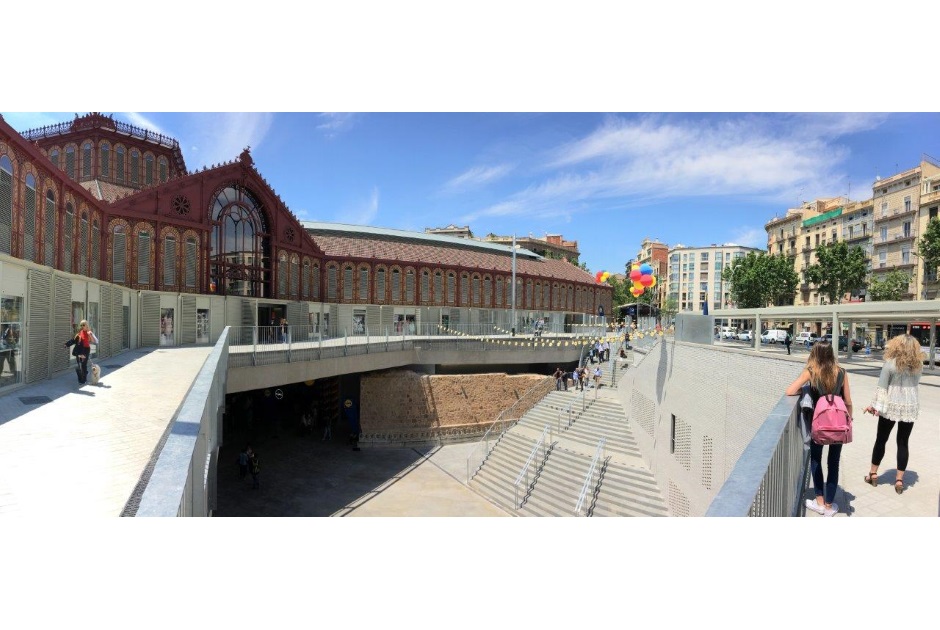
In 2007, the Instituto Municipal de Mercats de Barcelona started the works to reform the Sant Antoni Market, which dates from 1882. The main objective is to maintain the traditional market use and to give it new uses and services that complement its activity with an investment of nearly €90 million. The reform is divided into two large actions:
– The rehabilitation of the historic building, maintaining its original appearance and uses but adapting them to the needs and demands of current users.
– The enlargement of the building to house a shopping area in addition to the existing market as well as generating a logistics area and a car park for customers. These new needs are solved with the building of four underground floors occupying the entire block under the level of the existing market. The -1 floor is used for a shopping area. The -3 floor contains the loading and unloading areas and stores for the market while the -2 and -4 floors are car parks. A total of 40,000 m2 of new built area was generated.
During the excavation of the basements, an old medieval wall and a branch of the Roman Via Augusta were found. These archaeological remains have been maintained and integrated into the new market structure, for which both elements required propping- the wall with a steel structure and the road with the sinking of tubes to support both on micro piles.
The opening of the new market is scheduled for the first quarter of 2018.
ROAD ACCESSES TO THE PORT OF BARCELONA
CLIENT: BARCELONA PORT AUTHORITY
Barcelona
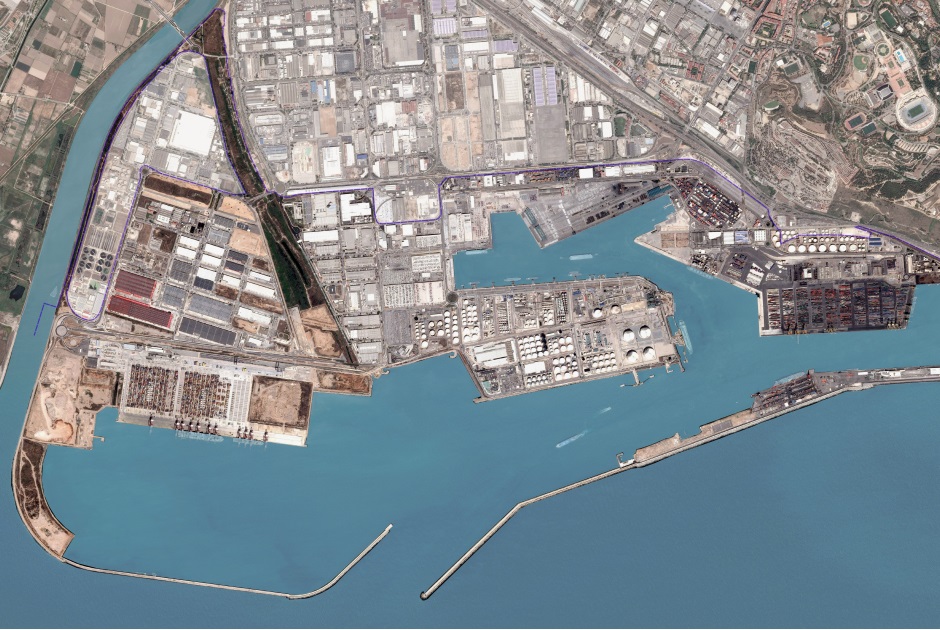
The designs of the road and railway accesses to the Port of Barcelona took numerous conditioners into account, including the start of the project to enlarge the new Tercat container terminal (Hutchison).
The initial study collected the existing information on the accesses and proposed a more suitable solution from the technical, economic and operational points of view. It designed two road nodes connected by the Prat road, the remodelling of Street 100 and Street 114 for access to the Prat road and a 3+3 road axis. For the railway accesses, the main proposal was to promote a railway ring to provide service and shunting for easier container transport and sidings were also proposed to serve the new terminal (a railway service branch for Decathlon).
The complexity of this project is in the undertaking of the various phases of the road and railway alignments, taking into account the structures to be designed to serve the future containers terminal in the Port of Barcelona.
The final objective is the preparation of the constructional project for phase 1 of the work for the new accesses to the southern enlargement of the Port of Barcelona according to the specifications in the existing documents.
COMPETITION TO ENLARGE THE CAMP NOU FOOTBALL STADIUM
CLIENT: MARTINEZ LAPEÑA AND ELÍAS TORRES
Barcelona (Spain)
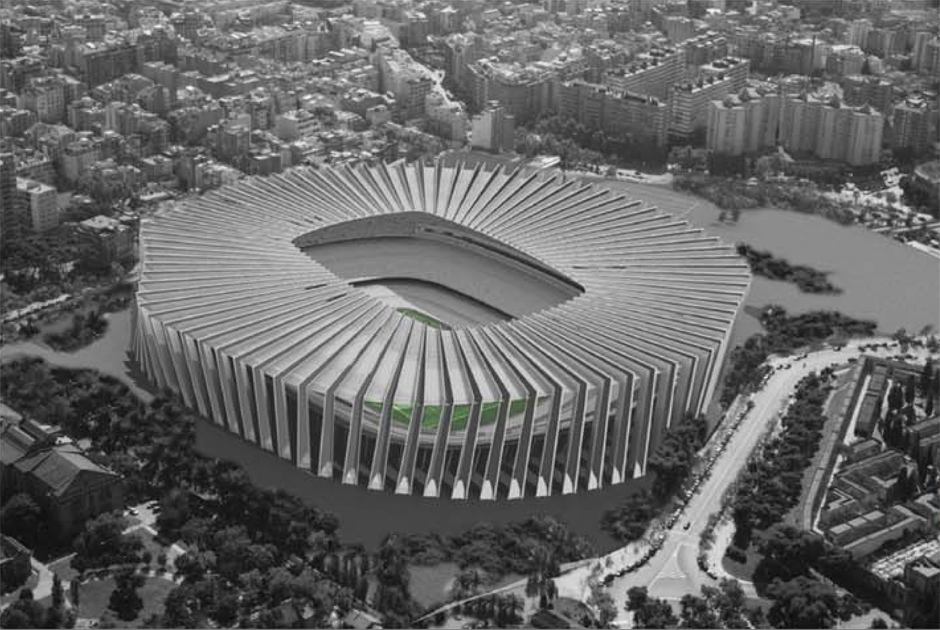
Competition for the project to enlarge the Camp Nou stadium, developed in collaboration with the Martínez Lapeña and Elías Torres architectural studio.
The remodelling of the stadium must encourage an essential urban transformation. The modernisation must not be an end but a means to approach this transformation and generate the resources necessary to carry it out.
The structure generates the image of the stadium and forms its public and urban spaces. Conceptually, it consists of a buried pedestal containing the functional spaces that serve as a powerful foundation for the new grandstand and for the steel ribs surrounding the grandstand and form the skin, roof and façade of the stadium.
The “pergola” structure, a succession of angular ribs, generates an atrium of 80 sloping columns.
The process of disassembling and building the third grandstand and the relevant part of the roof was designed to ensure the continuity of football games throughout the process.


 Español